Keeping AI search current when documents change
Keep AI search accurate after document edits, deletions and permission changes, with versioned chunks, cache handling and lifecycle tests.

Suppose a policy document changes on Monday. On Thursday, the search assistant still quotes the old version. The answer has a citation, the link opens successfully, and the customer receives instructions the business no longer follows.
A citation identifies a source. It does not establish that the search index contains its current contents. Keeping an AI search system useful requires handling edits, deletions and access changes throughout the path from source document to answer.
Give a document a stable identity
A file name is a poor identifier if people rename files or move folders. Where the source provides a stable document ID, retain it alongside the current location. Store a source version, content fingerprint or modification marker so the ingestion process can distinguish an edit from a repeated delivery.
Each indexed chunk should point back to that document and the version from which it was made. If the system only stores anonymous passages, removing every chunk of a superseded document becomes an investigation.
Keep the source URL separately from the identity. A moved document may need its citation location updated without being treated as an unrelated new policy.
Replace a version completely
An edited document may become shorter, merge sections or lose a table. Updating the chunks whose identifiers still match can leave old chunks behind. Those remnants can continue supplying answers even though their text is absent from the current file.
Track the set of chunks produced for each version. Prepare the replacement, check that extraction succeeded, and make it searchable using the index’s supported update mechanism. Remove the superseded chunks as part of the replacement process. If the store cannot switch a version atomically, define how queries avoid combining incompatible versions during that window.
Record which version is active. A failed indexing attempt should be visible rather than silently making a partial replacement look complete.
Treat deletion as its own event
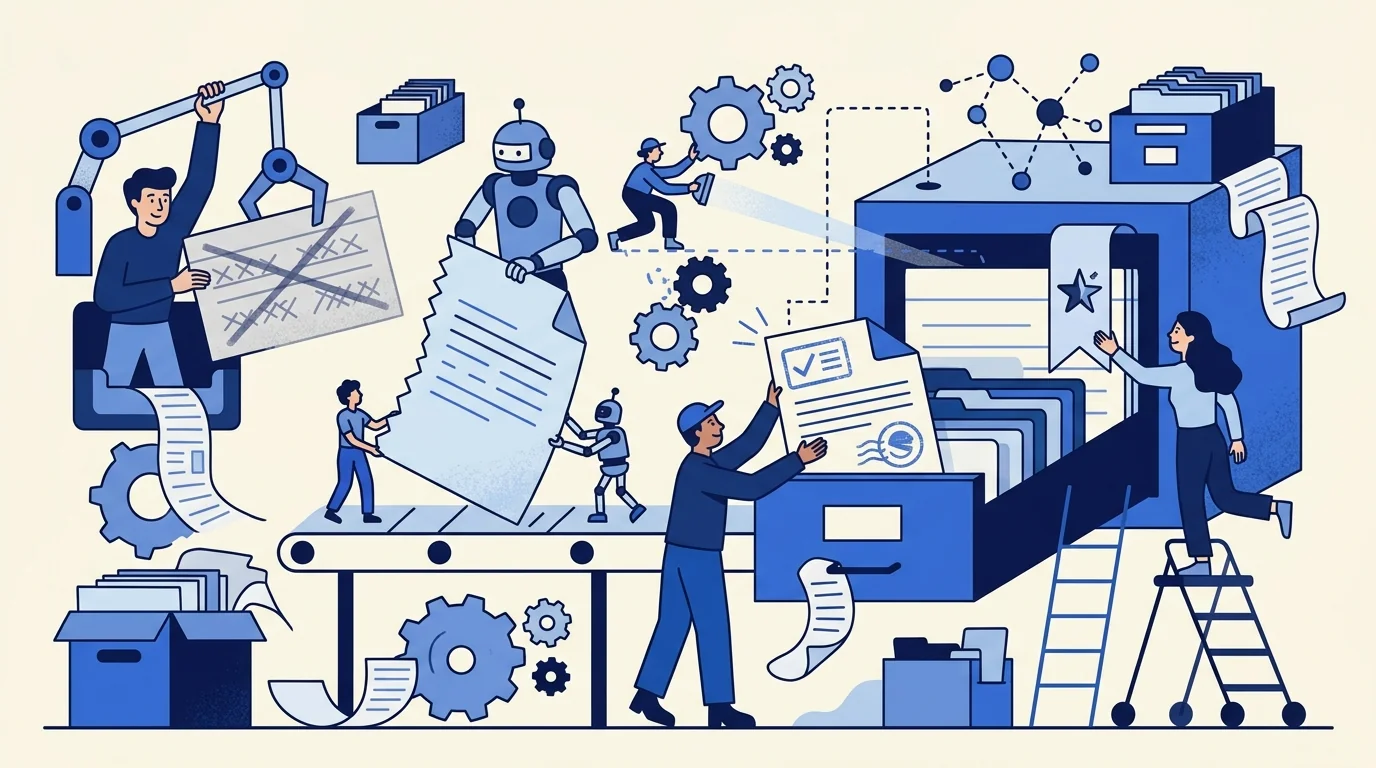
Detecting changes does not necessarily detect disappearance. Microsoft’s Azure AI Search documentation makes that distinction for its storage indexers: detecting object updates does not by itself remove index records for deleted source objects. Deletion handling needs a configured strategy.
For your integration, check what the source actually exposes. It may offer a deletion event, a soft-delete marker or a complete listing that can be reconciled against the index. Do not assume that the absence of a file from one failed listing means it was deleted.
Keep enough processing history to distinguish an intentional removal from a broken connector. Once a deletion is confirmed, remove the associated chunks and invalidate any answer caches that might still quote them.
Permission changes can make an unchanged document unsafe
A document can keep the same text while its audience changes. A folder may become restricted, an employee may leave a team, or a customer account may lose access to a record.
Include permission updates in the freshness design. A current text index with stale access metadata can expose information to the wrong reader. Check authorisation before using retrieved material to construct an answer, and decide what happens when the permission service is unavailable.
Cached answers need the same treatment. A cache shared across users must not serve an answer assembled from material that the current reader cannot access.
Test the lifecycle with questions
Start with a document whose answer you know. Index it, ask the question and record the source version returned. Then change the answer, reindex and ask again. Confirm that the old passage no longer contributes.
Repeat the exercise after deleting the document and after restricting its audience. Include a failed reindex, a renamed file and an edit that removes a whole section. These checks exercise the integration’s behaviour rather than merely checking that a scheduled job ran.
The broader retrieval-quality evaluation still applies: a fresh document can be retrieved badly, and a perfectly retrieved passage can still be misrepresented in the answer.
Report the lag people need to know about
Track when a source changed, when ingestion observed it and when the searchable version became active. These timestamps reveal whether a stale answer comes from source discovery, processing delay or an index update that never finished.
Choose acceptable delay from the use case. A frequently changing operational policy may need different handling from an archive of historical reports. If freshness cannot be established, the interface should say that plainly and direct the reader to the current source rather than implying a check that did not occur.
Run periodic reconciliation alongside change notifications where the source supports it. The recovery trade-offs are covered in webhooks versus polling. Use the resulting discrepancies to repair the index and add regression cases, preserving the evidence needed to explain what happened.