Retrieval-Augmented Search: Making Company Knowledge Actually Trustworthy
A search bar that answers in sentences is easy to demo. Getting people to actually trust it instead of asking a colleague is a different problem entirely.
Retrieval-augmented generation has become the default answer to “our documentation is scattered and nobody can find anything.” Point a model at a pile of documents, let it search before answering, and the search bar starts responding in sentences instead of a list of links. The demo takes an afternoon and it is genuinely impressive the first time you see it work.
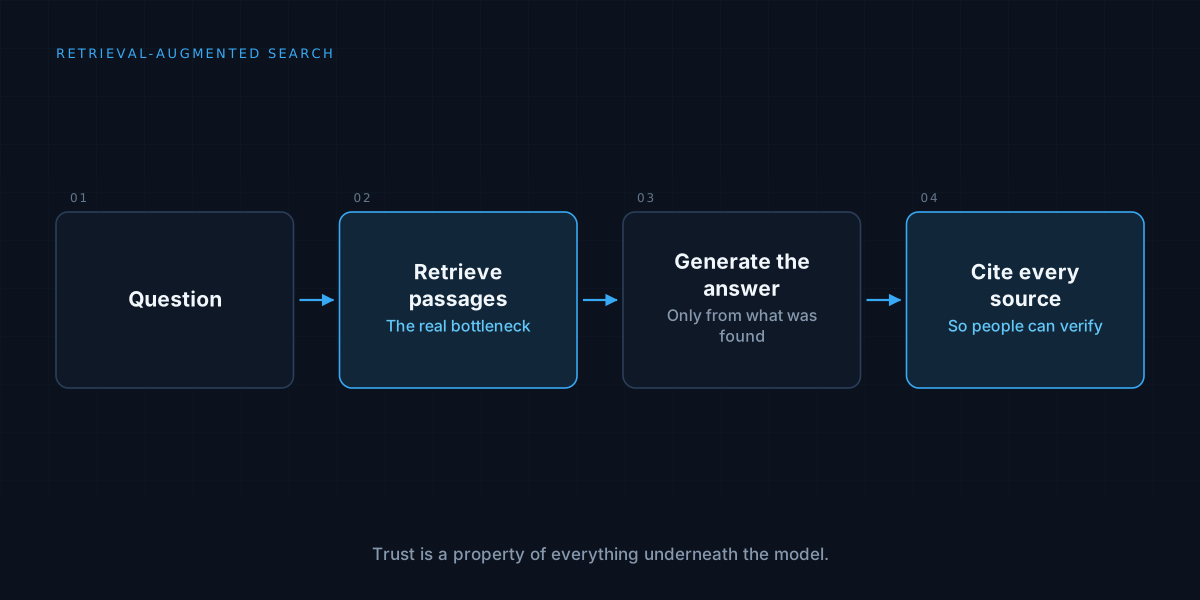
The gap between that demo and something people actually rely on instead of asking a colleague is almost entirely about trust, and trust is a property of everything underneath the language model, not the model itself.
Retrieval is the bottleneck, not generation
The model’s job in a RAG system is comparatively easy: given the right passages, write a coherent answer that uses them. Frontier models are good at this already, and getting better at it is not where the returns are.
The hard part is making sure the right passages arrive in front of the model in the first place. A document gets split into chunks, those chunks get embedded, and a query gets matched against them by similarity. Every one of those steps can quietly go wrong. Chunk a document at the wrong boundaries and you sever a table from its caption or a clause from the sentence that defines the term it depends on. Embed with a model poorly suited to your domain’s vocabulary and a legal term or an internal product name stops matching anything sensible. Rely on pure semantic similarity and a query using different words than the source document, which is most real queries, returns nothing useful at all, even though the answer is sitting right there.
Hybrid retrieval, keyword search running alongside semantic search, catches a meaningful share of what pure similarity misses, particularly for exact terms, product names, and anything where the literal words matter as much as the meaning. Most production systems that actually work use both, not one or the other.
Citations are not a nice-to-have
An answer without a source is a claim. An answer with a source next to it is something a person can verify in five seconds, and that difference decides whether anyone trusts the system enough to stop double-checking with a colleague, which is the entire point of building it.
This is not a UI afterthought bolted onto the response. It has to be architectural: the system needs to know, for every sentence in its answer, which specific passage that sentence came from, which means the retrieval and generation steps have to stay linked all the way through rather than the model just being handed a pile of context and trusted to remember where each fact came from. Systems that skip this step produce answers that sound exactly as confident whether they are grounded in a real document or quietly invented, and a reader has no way to tell the difference until it costs them something.
A corpus that goes stale is worse than no search at all
The uncomfortable failure mode is silent staleness. A policy document gets updated, the old version stays indexed, and the system keeps confidently citing the outdated one because nothing told it otherwise. A user who trusts the system less would have gone and checked manually. A user who trusts it precisely as much as the interface earned believes the stale answer, and now the system has actively made things worse than doing nothing at all would have.
Freshness has to be an explicit part of the design, not an assumption. That means a defined re-indexing schedule tied to how often the underlying documents actually change, a way to detect when a source document has been deleted or superseded so its content stops surfacing, and ideally a visible timestamp on results so a reader can judge staleness themselves rather than trusting the system’s implicit claim that everything shown is current.
How to know if it is actually good enough
The same discipline that applies to evaluating an AI agent applies here, and skipping it is the same mistake in a different outfit. A handful of demo questions that happen to work is not evaluation. A real test needs a set of genuine questions people actually ask, with known-correct answers and the specific source passages that should back them, checked regularly as the corpus changes and the retrieval logic gets tuned.
What that measurement should track is whether the retrieval step actually surfaced the correct passage in the first place, not just whether the final answer sounds right, since a wrong retrieval with a fluent answer built on top of it is a failure that reads exactly like a success until someone checks the source.
Buy the commodity layer, build the judgment
Most of what a RAG system needs, vector storage, an embedding API, a capable model to write the final answer, is genuinely commodity infrastructure at this point, and building any of that from scratch is time spent on the wrong problem. That is the same logic laid out in build vs buy: buy the parts that are not your differentiator, and spend the actual engineering effort on the part that is specific to your business, which here is the chunking strategy, the retrieval tuning, and the evaluation harness that tells you whether any of it is actually working. That is where the real difference between a demo and something people rely on daily actually lives.
We build search and knowledge systems people trust enough to stop asking a colleague. See how we approach applications, or read about the evaluation discipline this borrows from.