Choosing a Tech Stack for an MVP: Boring Is a Feature
The stack for a first version should be the one that is easiest to change, hire for, and keep running. Novelty is a cost you pay before you have users.
Stack decisions get an outsized share of attention at the start of a project. Teams debate frameworks, databases, and hosting for weeks, as though the right combination were the thing standing between the idea and a working product. It is rarely the constraint.
What matters at the start is how quickly the first version reaches real users and how cheaply it can change once it does. Those are different criteria from the ones that make a stack exciting, and the gap between them is where most early technology mistakes live.
The goal is optionality, not optimality
Nobody knows what the product needs to be yet. The first version exists to find out. That means the best stack is the one that keeps the most options open: easy to change direction, easy to extend, and unlikely to force a rewrite when the first assumption turns out to be wrong.
Choosing for the imagined scale of a successful product is the common error. The system that serves a million users and the system that gets the first fifty are not the same, and most of the machinery for the first is dead weight for the second. Building it early costs time you do not have and complexity you will pay for in every change.
Prefer what the team already knows
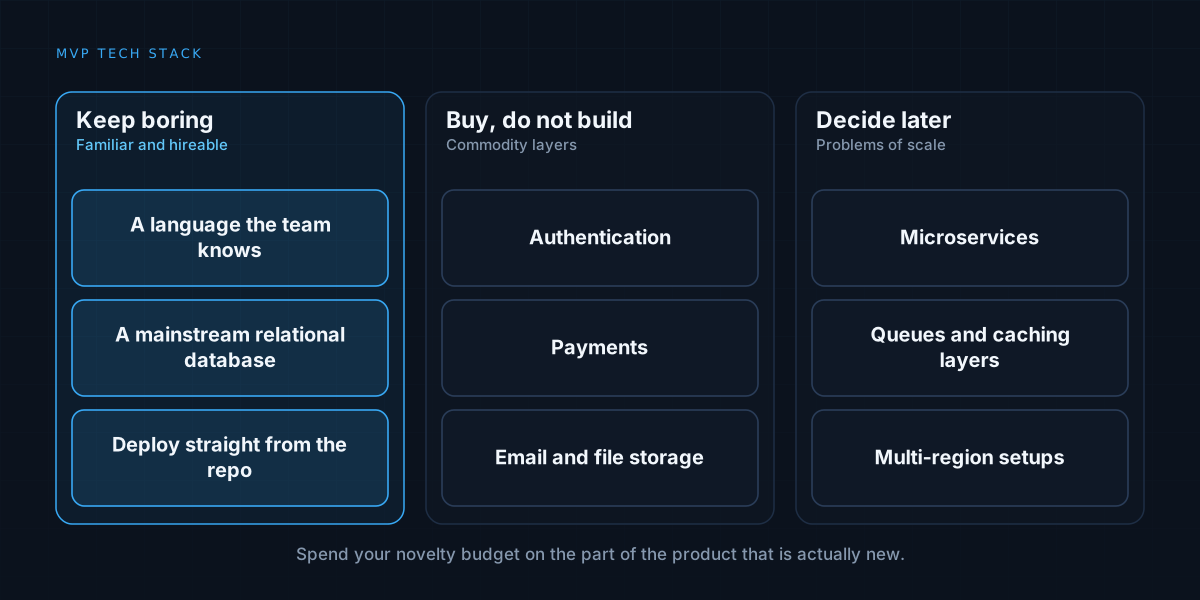
The strongest predictor of how fast a team ships is how well it knows its tools. A familiar stack means fewer surprises, faster debugging, and fewer hours lost to problems that someone has already solved. An unfamiliar one, however well regarded, taxes every task with the cost of learning.
This is the argument against choosing a technology because it is fashionable or because it would be interesting to learn. A first version is not the place to pay for that education. If a tool is genuinely better for the problem, the gain has to clearly outweigh the cost of the team becoming fluent, and for an MVP it usually does not.
Choose for the people you will need to find
A stack is also a hiring decision. Whoever builds the first version will eventually hand some of it over, whether to an employee, a contractor, or an agency. A widely used stack has a deep pool of people who can pick it up. A niche one narrows that pool, raises the price, and makes the project dependent on whoever happens to know it.
The same logic applies to the ecosystem. Mature tools have documentation, libraries, and answered questions for almost every problem you will hit. That accumulated help is a real asset, and it is invisible until you are stuck.
Pick the database like it will outlive everything else
Of all the choices, the data store is the hardest to change. Interface code can be rewritten; the shape of the data and the system holding it tend to stay. That makes it the one decision worth real thought, and it is why the guidance for most products is a mainstream relational database unless there is a specific reason otherwise.
Relational databases enforce structure, support the queries you have not thought of yet, and are understood almost everywhere. They also handle far more scale than early products need. If the product will serve more than one customer, tenancy belongs in the schema from the start, as covered in multi-tenant SaaS architecture, because retrofitting it later is among the most expensive changes there is.
For a tool used by one person on one machine, even that may be more than needed, which is the case made in local-first software.
Buy the commodity layers
Authentication, payments, email delivery, file storage, and error tracking are solved problems with mature providers. Building them yourself is rarely a good use of early time, and the edge cases are more numerous than they look. Buying them is the same reasoning as in build vs buy: spend engineering effort where it differentiates the product, and rent the rest.
The point is not that custom is wrong. It is that the first version has limited effort to spend, and it should go where it is most likely to matter.
Keep deployment boring too
Hosting is another place where simplicity pays. A platform that deploys from a repository, handles certificates, and scales without attention removes a whole category of work. A bespoke infrastructure setup can be the right answer later. At the start it is time spent on something users will never see.
What does matter early is that deployment is repeatable and that there is a way to see errors. Those two things protect the schedule more than any choice of cloud provider.
What should not be decided yet
Resist settling questions the product has not asked. Microservices, message queues, elaborate caching, and multi-region setups all solve problems that appear at scale. Adding them before the problem exists means carrying their complexity without their benefit.
A well-organised single application is easier to build, change, and reason about, and it can be split later along real seams once those seams are visible. Seams drawn in advance are usually in the wrong place.
The test for a good choice
Ask three questions of any technology. Can the team use it productively this week? Can we hire for it or hand it to someone else without trouble? And if the product changes direction, will it get in the way? A choice that passes all three is a good one, even if it is dull.
Dull is the point. The interesting part of the project is the product, and the stack’s job is to stay out of its way.
We scope and build products on this principle. See how we work, or read about how to scope an AI MVP that actually ships.