Webhooks vs Polling: Choosing How Your Automation Hears About Change
Webhooks are fast and fragile, polling is slow and sturdy. Most reliable systems use both, with the poll as the safety net behind the event.
Every automation that reacts to something in another system has to answer one question first: how does it find out that something happened? There are two basic answers. Either the other system tells you, or you keep asking it.
Both are legitimate, and the choice is usually framed as a matter of speed. It is mostly a matter of failure. The two approaches break in opposite ways, and a design that understands how each one breaks is far more reliable than one that simply picks the faster option.
What each one actually is
A webhook is the other system calling you. When something changes, it sends an HTTP request to an address you gave it, carrying details of the event. You do nothing until it arrives.
Polling is you calling the other system, on a schedule. Every few minutes, your automation asks what has changed since last time and processes whatever comes back.
The practical difference is who holds the responsibility for noticing. With a webhook, the other system has to deliver the message and you have to be there to receive it. With polling, you are responsible for asking often enough and for remembering where you left off.
Why webhooks are attractive
They are fast, because the event arrives as it happens, without waiting for the next poll. They are efficient, because nothing is sent when nothing changes. And they scale well with quiet systems, where a poller would spend most of its time asking and hearing nothing.
For anything where latency matters, such as reacting to a payment or a reply, a webhook is the natural fit.
Why webhooks are fragile
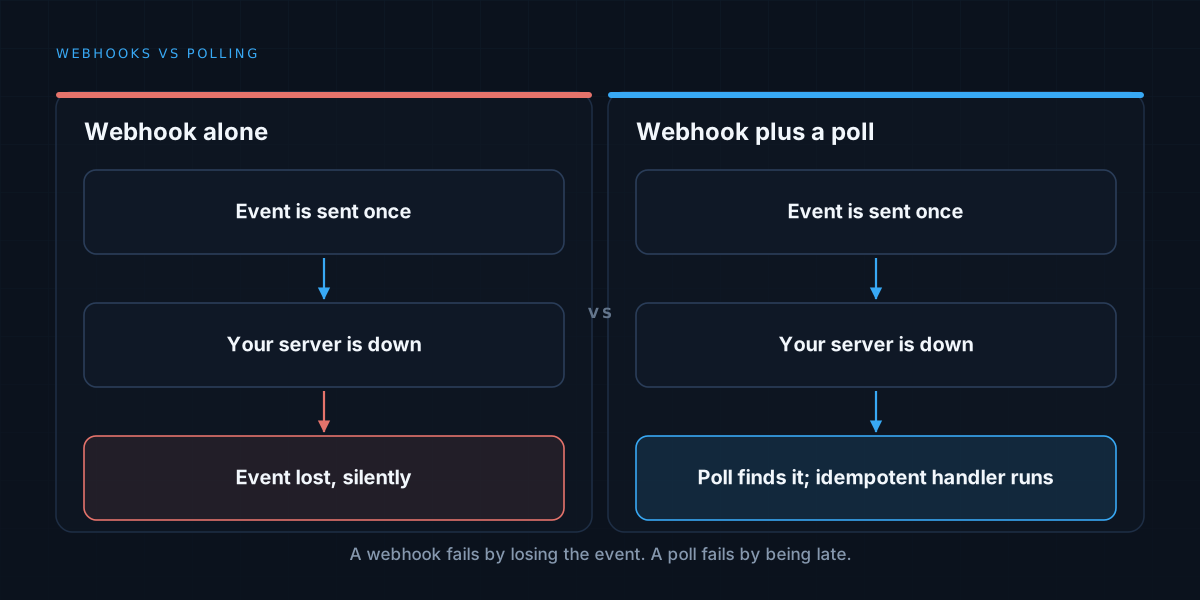
The weakness is that a webhook is a single delivery attempt in a world where things fail. Your server may be down for a deployment when the event arrives. The sender may give up after a few retries. A network problem may swallow the request. An event may arrive twice, or out of order.
Most providers retry on failure and promise at-least-once delivery, but that promise has limits: retry windows end, and a long outage on your side can outlast them. When it does, the event is simply gone, and nothing in your system knows it was missed.
That last point is the real danger. A missed webhook is silent. There is no error on your side, because nothing happened on your side. The first sign is usually a customer or a report noticing that something never got processed.
Why polling is sturdy and why it is not enough
Polling fails the other way. It is slower, because change is noticed only at the next interval, and it wastes calls when little is happening. But it is self-healing. If your poller is down for an hour, it asks again when it comes back and finds everything that changed in the meantime. A missed cycle costs delay, never data.
The cost is that polling has its own traps. Rate limits cap how often you can ask. Large result sets need pagination done correctly. And “what changed since last time” depends on a reliable checkpoint: a stored timestamp or cursor that must itself survive restarts and handle records updated at the boundary.
The pattern that holds up: both
The most reliable designs do not choose. They use the webhook for speed and the poll as the safety net.
The webhook handles the normal case: the event arrives, gets processed, and the system reacts within seconds. Behind it, a slower poll, perhaps every few minutes or hourly depending on the stakes, asks the source for anything that changed and checks whether it has already been handled. If a webhook was missed, the poll finds the gap and fills it.
This only works if processing is safe to repeat, because now the same change may arrive twice, once by each route. That is exactly the problem covered in idempotent automation: give each event a stable identifier, record what has been processed, and make the handler indifferent to duplicates. With that in place, redundancy becomes cheap, and the two mechanisms cover each other’s weaknesses.
Handling the webhook side well
A few habits make the webhook half dependable. Acknowledge quickly and do the real work afterwards, so the sender does not time out and resend while you are still processing. Verify the signature the provider attaches, so you only act on genuine events. Store the raw event before doing anything else, so a processing bug can be replayed instead of lost.
And design for disorder. Events can arrive in the wrong sequence, so a handler that applies state changes based on the current record, instead of assuming a fixed order, is far less likely to corrupt data.
When to use which
Use a webhook alone when the event is low-stakes or the cost of a miss is small. Use polling alone when the source offers no webhooks, when you need predictable load, or when a delay of minutes is fine. Use both when a missed event costs money, trust, or hours of cleanup, which covers most processes anyone cares about.
The question to ask is not which is faster. It is what happens the one time the message does not arrive, and whether anything in the system would ever notice.
We build automation that notices what it missed. See how we approach workflow automation, or read about monitoring agents that do not cry wolf.