Dead-Letter Queues: Where Failed Automation Jobs Should Go
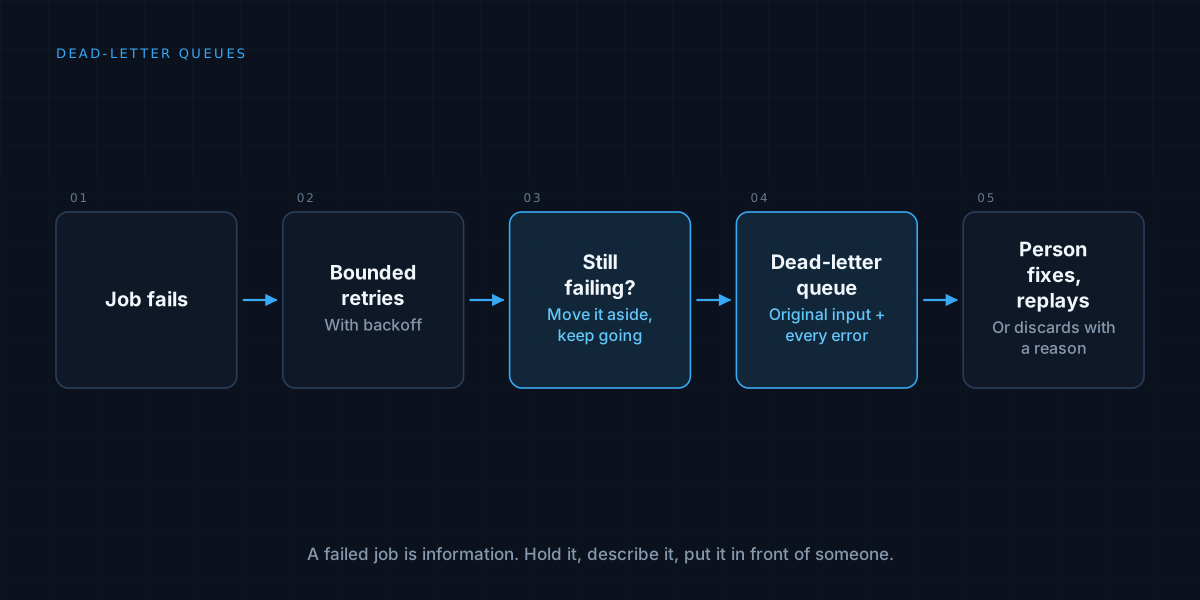
A job that keeps failing should not retry forever or vanish. A dead-letter queue holds it somewhere visible, with enough context for a person to fix it.
Every automation eventually meets a job it cannot finish. A record with a malformed field, a document nobody planned for, a downstream system that rejects one specific request every time. What the system does with that job decides whether the problem is a small, visible task or a quiet, growing mess.
There are two bad defaults. The first is to retry forever, which burns resources and blocks everything behind the stuck job. The second is to drop it after a few attempts and move on, which means a customer’s order, an invoice, or a lead simply disappears and nobody knows. A dead-letter queue is the third option, and it is almost always the right one.
What a dead-letter queue is
It is a holding area for jobs that have failed too many times to keep trying automatically. Instead of discarding the job or retrying without end, the system moves it aside, keeps everything needed to understand it, and carries on with the rest of the work.
The name comes from postal systems, where undeliverable mail went to a separate office rather than being thrown away. The principle is identical: something that cannot be delivered still has an owner who needs to decide what happens to it.
Why retrying forever is wrong
Not every failure is temporary. A retry fixes a network blip or a brief outage. It cannot fix a record that is structurally invalid, because the next attempt fails for the same reason as the last one.
Unbounded retries have costs. They consume capacity, they can hammer a struggling downstream service, and in a queue that processes jobs in order they can block everything behind the stuck item. A single poison job can stall a whole pipeline.
This is the distinction drawn in durable pipelines when it describes per-stage retry policies: transient failures deserve patience, and permanent ones deserve to be recognised quickly and routed elsewhere.
Why dropping it is worse
Discarding a failed job feels tidy and is dangerous. The work was real, and its failure means something did not happen that should have. Silent loss is the worst outcome in automation because nothing flags it. The first sign is usually a person noticing that something never arrived.
Decide when a job is “dead”
The rule is simple to state and needs care in practice: after a bounded number of attempts, with sensible backoff between them, move the job aside.
It helps to classify failures first. Transient errors, such as timeouts and rate limits, justify several retries with increasing delays. Permanent errors, such as validation failures or a clear rejection from the destination, do not, and can go to the dead-letter queue immediately. The ambiguous cases, where you cannot tell, should lean toward more attempts and then escalation. Getting the safe handling of repeated attempts right also depends on the job being safe to run twice, as covered in idempotent automation.
Keep enough context to act
A dead-letter queue is only useful if each entry explains itself. Store the original payload exactly as received, the error from each attempt, the stage where it failed, how many times it was tried, and timestamps. Someone should be able to read one entry and understand what went wrong without digging through logs.
Keep the original input unmodified. If a bug caused the failure, the fixed system should be able to replay the exact job as it first arrived.
Someone has to own the queue
A dead-letter queue nobody looks at is just a slower way to lose data. It needs an owner, a way to be notified, and a rhythm for review.
Alert when entries appear, and alert louder when they accumulate. A single dead job may be an odd record. A sudden cluster usually means a change upstream, a deployment bug, or a dependency that has started rejecting things. The pattern across entries is often more useful than any single one, which is where the thinking in building a monitoring agent applies: surface what matters, and do not drown the reader.
Make resolution a first-class action
For each entry, a person should have clear choices: fix the data and replay it, fix the system and replay it, or deliberately discard it with a recorded reason. Replay should be a button or a command, not a manual reconstruction.
Closing the loop matters too. Track how long entries sit, how many are resolved, and which causes recur. Repeated causes are a signal to fix the underlying cause instead of clearing the symptoms.
When you do not need one
A tiny automation that runs a few times a day and alerts a person on any error does not need queue infrastructure. A clear alert and a simple log can be enough. The dead-letter pattern earns its cost when volume is high enough that you cannot watch every run, or when a lost job has real consequences.
We build automation that fails visibly and recovers cleanly. See how we approach workflow automation, or read about choosing between no-code and custom automation.