Automated Reporting: Turning Scattered Numbers Into One You Trust
The monthly reporting scramble is a trust problem, not a scheduling one. Automating the pull without the trust just delivers the wrong number faster.
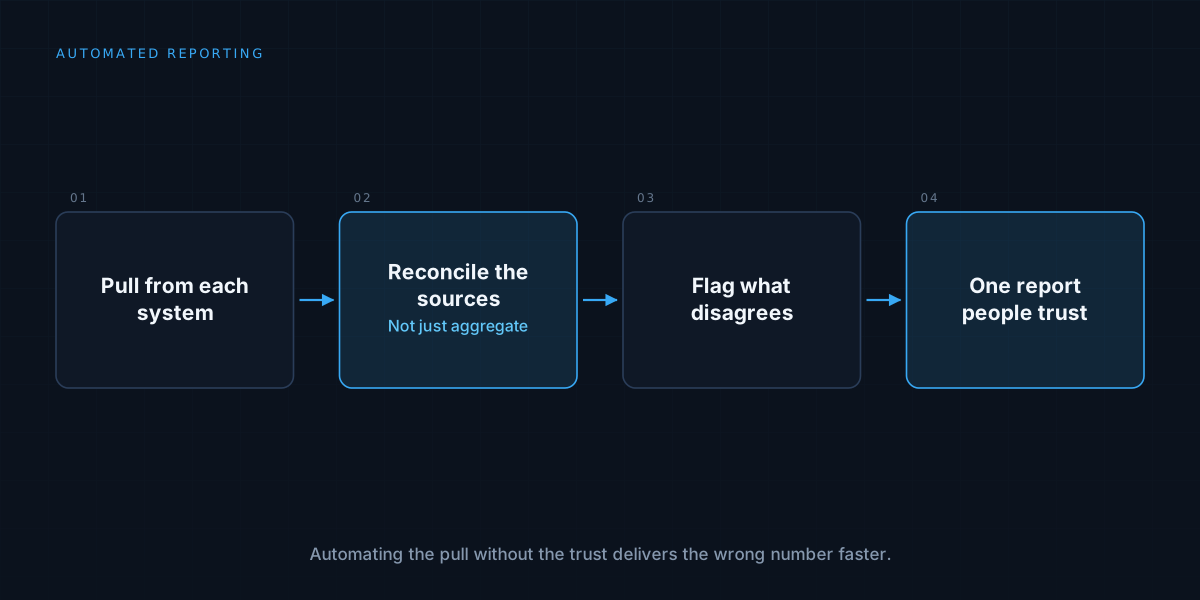
Every business past a certain size has a version of the same monthly ritual: someone pulls numbers from three or four systems that do not talk to each other, reconciles them by hand, and produces a report that is, by the time anyone reads it, already a little stale. Automating the pull is the obvious first move, and it is also the smaller half of the actual problem.
The harder half is trust. A report that arrives faster but that nobody quite believes has not actually solved anything, it has just moved the informal cross-checking from before the report to after it.
Reconciliation, not just aggregation
Pulling numbers from multiple sources into one place is aggregation. Making sure those numbers actually agree with each other, or flagging clearly when they do not, is reconciliation, and it is the step a lot of reporting automation skips.
Two systems that are both individually correct can still disagree, because they update on different schedules, because one includes a category the other excludes, or because a sync between them failed silently three weeks ago and nobody noticed. A reporting system that aggregates without reconciling will confidently present a number that is wrong in exactly the way that erodes trust fastest: it looks precise, it looks current, and it is quietly built on a mismatch nobody caught.
This is the same principle behind data enrichment automation, applied to numbers instead of records: when two sources disagree, something has to actually decide which one wins, using a real rule, rather than the report simply presenting whichever value happened to load first.
Live does not always mean better
There is a real temptation to build every reporting system as a live dashboard, refreshing continuously, because that sounds like the more impressive version. For a lot of reporting, it is the wrong choice.
A number that changes while someone is looking at it, mid-review, mid-meeting, is harder to reason about than a number that was correct as of a stated point in time. Financial and operational reporting in particular often benefits from a clearly timestamped snapshot rather than a live feed, because the point of the report is usually to support a decision made at a specific moment, and a live number undermines the stability that decision needs. Live dashboards earn their place for operational monitoring, where the point is to see something changing in real time. They are often the wrong shape for the monthly numbers a leadership team actually needs to sit with.
Where the manual step actually adds value, keep it
Full automation is not always the improvement it sounds like. Some reconciliation genuinely benefits from a person’s judgment, particularly around edge cases a rule was never written to handle, and removing that judgment entirely in the name of automation can make a report faster and less trustworthy at the same time.
The better target is usually automating the ninety percent of the reconciliation that is genuinely mechanical, exact matches, known category mappings, straightforward sums, while surfacing the remaining ten percent to a person with enough context to resolve it in minutes rather than starting the whole reconciliation over by hand. This mirrors the review-queue pattern from automating document processing: confident cases proceed automatically, and the ones that are not confident get flagged specifically, rather than the whole process either being fully manual or fully opaque.
What this looked like in practice
We built exactly this for a business that was reconciling commission payments against attribution data by hand every month, two systems that were each correct on their own and routinely disagreed with each other once combined. The fix was not a live dashboard. It was a relational model that made attribution explicit rather than buried in a spreadsheet formula chain, automated matching for the confident majority of records, and a clear surface for the unmatched ones, which turned out to be the actually valuable output, since the exceptions were exactly where the previous process had been quietly getting things wrong.
The report that came out the other side was smaller and less impressive-looking than a live dashboard would have been. It was also the first version anyone actually trusted without re-checking it themselves, which was the entire point.
We build reporting systems people stop double-checking. See the Commission Tracker case study, or read about how we approach automation.