Multi-Agent Orchestration: When One Agent Is Not the Right Shape
Splitting a task across several specialist agents is a specific answer to a specific problem, and it is the wrong answer most of the time.
Multi-agent systems get reached for the way microservices did a decade ago: as a default architecture rather than a considered answer to a specific problem. The reasoning usually sounds plausible. One agent doing everything feels unwieldy, so splitting it into specialists feels like the more serious, more scalable design.
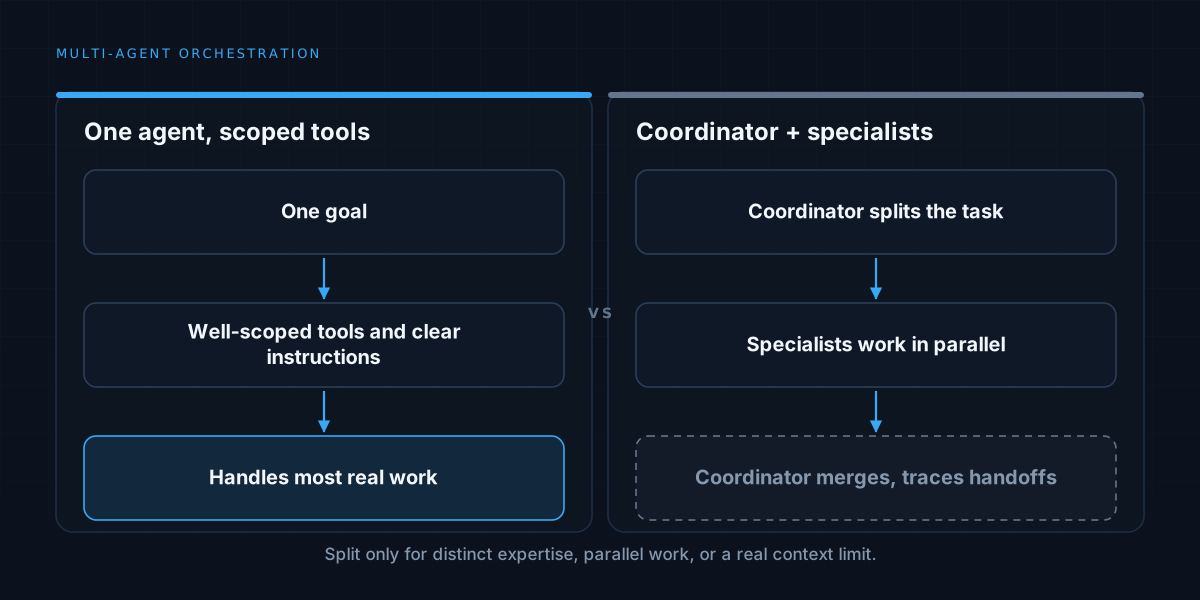
Most of the time it is the wrong instinct. A single agent with a well-scoped set of tools handles the large majority of real work, and reaching for multiple agents before that single agent has actually run out of road adds coordination overhead for no return.
What actually forces the split
There are a small number of real reasons to run more than one agent, and they are all about the shape of the work, not its size.
The clearest one is genuinely distinct expertise. A research step and a drafting step benefit from different prompts, different tools, and sometimes different models entirely, because optimising a single prompt to do both well tends to make it worse at each individually. When the two halves of a task pull in different directions like that, separating them into two agents with their own focused instructions is a real improvement, not just added structure.
The second is parallel, independent work. If five documents need the same analysis and none of them depend on each other’s output, running five instances of the same agent concurrently is faster than one agent working through them in sequence, and this is closer to a scaling technique than an architectural one. It does not require different agents, just more of the same one running at once.
The third, and the one people reach for too early, is a task large enough that a single context window genuinely cannot hold everything relevant at once. This is real, but it is rarer than it looks. Most tasks that feel too large for one agent are actually one agent with too little structure, not one agent with too little context.
The coordinator is the hard part
Once a task genuinely needs multiple agents, the interesting engineering is the coordinator, the part that decomposes the task, routes pieces to the right specialist, and reconciles their outputs into one coherent result.
That coordinator has to make real decisions: which specialist handles which sub-task, what happens when two specialists produce conflicting information, and when the overall task is actually done versus still needing another round. Each of those is a place a multi-agent system can quietly fail in a way a single agent never would, because a single agent’s failure mode is usually “got the wrong answer,” while a coordinator’s failure mode can be “got a plausible-sounding answer built from two specialists that silently disagreed and nobody caught it.”
This is where the guardrail discipline covered in AI agent guardrails matters even more than in a single-agent system. Every specialist needs its own scoped permissions, and the coordinator needs its own approval gates on anything irreversible, because now there are more places an action could originate from, not fewer.
Handoffs need to be traceable
A coordinator that hands work to a specialist and receives an answer back needs to log that handoff the same way a single agent logs a tool call: what was asked, what was returned, and why the coordinator accepted or rejected it. Skip this and debugging a multi-agent system becomes close to impossible, because the failure could have originated in any of several places and there is no record of which one actually produced the bad output.
This is not a new discipline invented for multi-agent systems. It is the same tracing requirement from why AI agents fail in production, applied at one more layer. A single untraced handoff is enough to turn a multi-agent system from something debuggable into something that only ever gets fixed by trial and error.
What good coordination actually looks like
A well-built multi-agent system reads, from the trace, almost like a well-run team. The coordinator states what it needs, delegates a bounded piece of work with clear inputs, receives a bounded result, and either accepts it or sends it back with a specific reason. Specialists do not talk directly to each other unless there is a real reason for it, because every additional path between agents is another place state can drift out of sync.
The test for whether the architecture is actually earning its complexity is simple: could a person unfamiliar with the system read the trace of one run and understand why each specialist was invoked. If the answer is no, the orchestration has probably grown past what the task actually required, and the fix is usually to cut agents, not add more structure around the ones already there.
We build multi-agent systems when the task genuinely calls for one, and a single well-scoped agent when it does not. See how we approach agent work, or read about evaluating whether any of it is actually working.